Funding visibility
Know what has been allocated, committed, spent and remains available.
Business Central for Not-for-Profits
Still reconciling funding, program costs and financial information across different systems?
Bring it together in Business Central for timely reporting, stronger oversight and confidence in every decision.

Most Not-for-Profit finance teams are not short of data. They are short of one trusted place where funding, program costs and reporting agree.
Grants, contracts and donations are tracked across separate systems and spreadsheets.
Every funder wants a different view of the same data, and each report is rebuilt manually.
Shared costs and staff time are allocated after the fact, limiting timely decisions.
Reserves, restricted funds and forecasts require manual explanation before the board pack is circulated.
Funder, audit and regulatory requirements increase while finance capacity remains limited.
Key reports depend on individual knowledge and manually maintained spreadsheets.
THE COST IS MORE THAN FINANCE TIME.
It is delayed insights. Weaker oversight. Less capacity to deliver your mission.
Microsoft Dynamics 365 Business Central connects finance, funding and program information in one trusted platform.
With all information in one place, your team can reduce manual reconciliation, strengthen oversight and respond to reporting requirements with greater confidence.
Track funding allocation, expenditure, commitments and available balances.
Understand program costs, commitments and financial performance.
Manage financial transactions, budgets and commitments in one system.
Bring financial, funding and program information into consistent reports.
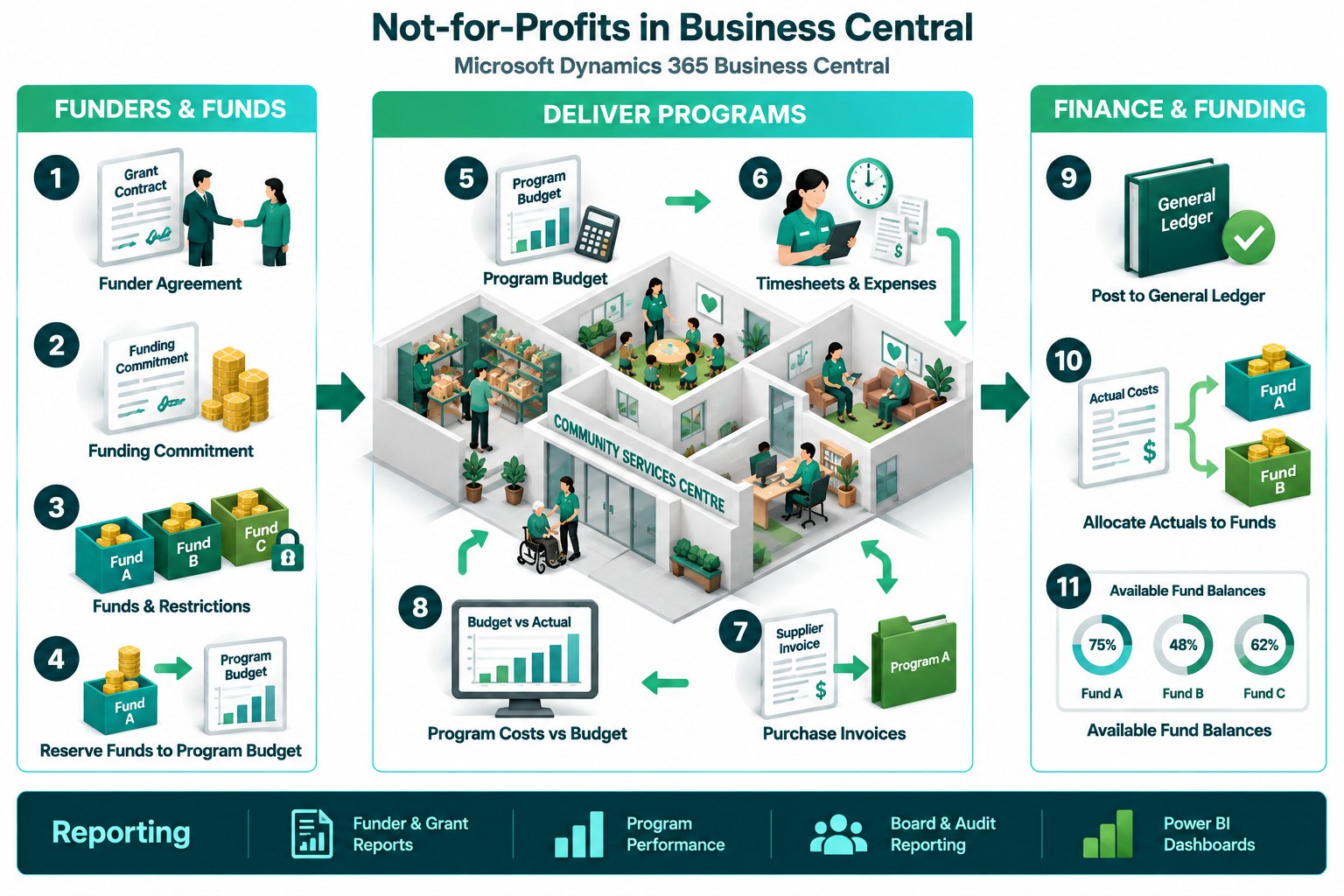
See how funding, commitments, program costs and finance connect in one platform.
Rapid Results is Conexio’s fixed-price approach to implementing Business Central for Not-for-Profit organisations.
The methodology has four structured stages, with an agreed scope and clear responsibilities from planning through to go-live.
Agree priorities, scope and desired outcomes.
Configure and test the processes your organisation relies on.
Prepare people, data and ways of working.
Move into everyday use.
FIXED PRICE · CLEAR SCOPE · ALIGNED GO-LIVE PLAN
Better visibility. Better decisions. Greater impact.
Know what has been allocated, committed, spent and remains available.
Understand program costs and commitments before decisions are made.
Use consistent information for management, board and funding reports.
Less reconciliation. Stronger oversight. More informed decisions.
When grants, program costs and reporting sit in separate spreadsheets, even simple financial questions take time to answer. Bring them together so your team can see where funding goes, what remains and which services need attention.
Each funder wants expenditure presented differently. Finance exports transactions, sorts costs into categories and checks supporting records—repeating the exercise for every reporting deadline.
We structure grant and program coding around your reporting needs, with agreed expenditure reports that trace back to the accounts. Your team starts with organised financial data rather than rebuilding each acquittal in a spreadsheet.
Cash in the bank includes funding reserved for specific purposes. Separate spreadsheets track restrictions and balances, making it difficult to see what is available for day-to-day operations.
We set up funding categories, budgets and reporting to distinguish receipts and expenditure by grant or program. Your team can review remaining balances alongside funding conditions before making spending decisions.
Staff, premises, vehicles and administration support several services, but their costs sit in central accounts. Program reports show direct spending without revealing the full cost of delivery.
We establish a repeatable process for allocating shared costs using agreed methods. Reports distinguish direct expenses from allocated overheads, helping you assess funding adequacy and program sustainability.
Each month, someone combines exports, checks formulas and explains differences between reports. Leadership waits for answers, while the reporting process depends on knowledge held by one person.
We configure financial and budget-versus-actual reports around the questions your board asks. Clear reporting structures and hands-on training help your team prepare and explain results without rebuilding the pack each month.
A program appears to have budget available, but equipment orders and supplier commitments have not reached the accounts. By the time invoices arrive, there is little room to adjust.
We connect purchasing to program and grant codes, establish approval workflows and scope reporting for outstanding purchase orders. Budget holders can review recorded spending and commitments before making further purchases.
Missing grant codes, inconsistent program names and late corrections leave finance chasing information. Reporting deadlines become a scramble to establish where costs belong.
We configure required financial coding, posting controls and approval processes around your structure. Your team follows a consistent way to record transactions, reducing avoidable corrections before reporting begins.
A typical Rapid Results implementation for Not-for-Profit takes between 5 and 9 weeks. The timeframe depends on the agreed scope, data readiness, integrations and the availability of your internal team. Before work begins, the implementation plan sets out target timing, key decisions and responsibilities so your organisation can confirm the plan is realistic.
The Fixed Price covers the agreed scope, deliverables, assumptions and Conexio responsibilities documented before implementation begins. Any requirement outside that scope is discussed and agreed before additional work proceeds.
Your team remains important throughout the implementation. Key people will need to contribute to decisions, process reviews, data preparation, testing and readiness for go-live. The exact commitment varies by scope and role, and is planned early so responsibilities are visible and the workload can be managed alongside day-to-day operations.
Business Central can support financial structures for funds, programs, grants, projects and reporting dimensions. The right design depends on your funding agreements, allocation methods, acquittal requirements and management reporting needs. These requirements are confirmed before configuration so the proposed structure reflects how your organisation needs to operate and report.
Existing data is assessed early in the project. Relevant records are identified, cleaned, mapped and tested before they are moved into Business Central. Your team validates the results so opening balances and agreed historical information are accurate. The amount of history migrated depends on reporting needs, data quality and the agreed implementation scope.
Fit is assessed against your reporting requirements, finance processes, funding complexity, integrations, organisational capacity and future needs. The discovery meeting is an initial conversation, not a commitment. If the platform or Rapid Results approach does not suit your requirements, Conexio will explain the concern and recommend a practical next step.
Still have a question? Bring it to the discovery meeting.
Book a 30-minute discovery meeting to discuss your finance systems, reporting requirements and whether Rapid Results for Business Central is the right fit.
No cost. No obligation.
If Business Central is not the right fit, we will tell you.
Prefer to talk? Choose a time that suits you and let’s discuss what you need.
Prefer email?
hello@conexio.com.au